







Motor Insurance
Out-of-Warranty EV Battery Insurance UAE 2026 Guide

As the UAE's first wave of mass-market electric vehicles from 2018–2019 approaches the 8-year mark, thousands of EV owners face a critical question: can you still get comprehensive cover once the battery warranty expires? Whether you drive a BYD, Nissan Leaf, or Tesla, understanding your options now could save you thousands. Explore your motor insurance options on eSanad before your next renewal.
Understanding EV Battery Degradation and UAE Warranty Standards
Most EV manufacturers offer battery warranties of 8 years or 160,000 km — whichever comes first. In 2026, the UAE market is hitting a pivotal inflection point: the earliest mass-market EVs registered here are now exiting that window simultaneously.
Battery degradation in the UAE is accelerated by one key factor competitors rarely address — heat. The GCC climate, with summer temperatures regularly exceeding 45°C, stresses lithium-ion cells far more aggressively than temperate markets. Studies referenced by DEWA's EV Green Charger initiative indicate that UAE-operated EV batteries can lose 20–30% capacity faster than European equivalents under comparable usage cycles.
Key warranty terms to understand:
- Manufacturer Battery Warranty: Typically covers defects and capacity drops below 70% within the warranty period
- Agency Repair Period: Often limited to 5 years for high-voltage components; review our guide on agency repair for EVs and the 3-year SUV milestone for context
- Battery Health Certificate (BHC): A 2026 requirement from several UAE insurers, confirming the battery retains sufficient capacity for insurability
Comprehensive vs. Third-Party: Insurance Eligibility for Aging EVs
The good news: an expired battery warranty does not automatically disqualify your EV from comprehensive cover in the UAE. However, what changes is how insurers price and structure that cover.
Third-Party Only (TPO): The minimum legal requirement under RTA regulations. This covers damage to other vehicles or property but provides zero protection for your own EV or its battery system.
Comprehensive Cover: Still available for out-of-warranty EVs in 2026, but with important caveats:
- Insurer discretion on battery exclusions: Some standard comprehensive policies now contain explicit clauses excluding high-voltage battery replacement unless damage results from a covered accident
- Depreciation schedules: Insurers calculate battery value using age and BHC scores, not OEM retail pricing
- Chinese EV brands (BYD, MG): Parts availability has improved significantly in 2026, but some insurers still apply loading premiums of 10–20% for these models — see our dedicated guide on insuring a used BYD or Geely in the UAE
The "Insure-ability Gap" emerges when the battery replacement cost (AED 30,000–80,000 depending on model) exceeds 50–60% of the car's current market value. At that point, insurers may deem any significant battery damage a constructive total loss. For more on how write-off thresholds work, the process mirrors total loss and write-off procedures in the UAE.
Key Factors: Battery Health Reports and Resale Value in 2026
Two variables now dominate how insurers assess out-of-warranty EVs: the Battery Health Certificate and the vehicle's depreciated market value.
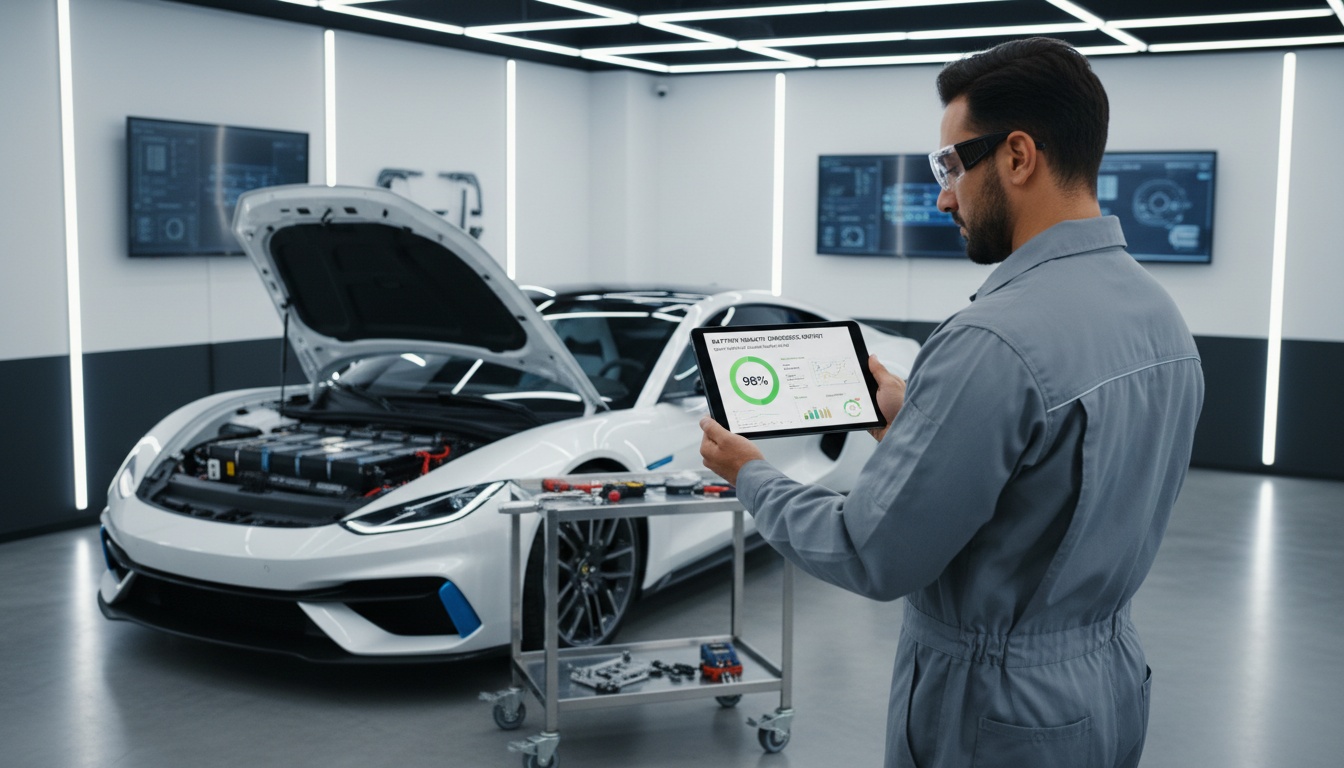
Battery Health Certificate (BHC): In 2026, several leading UAE insurers have moved to make BHC submission mandatory at comprehensive renewal for EVs over 5 years old. Issued by approved service centres or OEM-certified technicians, a BHC confirms:
- State of Health (SoH) percentage
- Remaining usable capacity
- Evidence of cell degradation patterns linked to heat cycling
Resale Value and Agreed Value Disputes: The market value of a 7–8-year-old EV in the UAE has compressed sharply. This directly affects comprehensive claims payouts. Owners of Chinese-brand EVs should pay particular attention — the dynamics around agreed value vs. market value for Chinese cars in UAE 2026 apply equally to EVs with degraded batteries, where insurer valuations can diverge significantly from owner expectations.
The UAE's National Electric Mobility Policy supports EV adoption but does not mandate insurers to cover batteries beyond standard depreciation frameworks set by the UAE Central Bank.
Compare & Choose a Plan
Checklist for Renewing Insurance on an Older Electric Vehicle
Use this checklist before your next renewal to avoid coverage gaps:
- Obtain a Battery Health Certificate from an approved technician at least 30 days before renewal
- Review your current policy's battery exclusion clauses — request a copy of the high-voltage component endorsement
- Get the vehicle independently valued — don't rely solely on the insurer's depreciation schedule
- Compare specialist EV comprehensive policies alongside standard comprehensive plans on the platform's motor insurance platform
- Ask about third-party battery warranty supplements — several providers now offer standalone battery protection that pairs with comprehensive cover
- Confirm agency repair status — after 5 years, most UAE EVs lose OEM agency repair eligibility; ensure your policy reflects non-agency repair pricing
- Declare all battery modifications — aftermarket thermal management upgrades must be disclosed
| Feature | Standard Comprehensive (In-Warranty) | Specialist EV Comprehensive (Out-of-Warranty) |
|---|---|---|
| High-Voltage Battery Replacement | Covered at OEM rate | Covered with depreciation / BHC adjustment |
| Dedicated EV Roadside Assistance | Sometimes included | Usually included as standard |
| Charging Cable & Wallbox Protection | Rarely included | Often available as add-on |
| Agency Repair | Yes (within 5 years) | Non-agency repair standard |
| Premium Impact | Base rate | 10–25% loading typical |
Get a Free Quote Now
Conclusion
Bottom line: Owning an out-of-warranty EV in the UAE in 2026 does not mean you're uninsurable — but it does mean standard policies may leave dangerous gaps around battery replacement costs and total loss thresholds. A Battery Health Certificate, an honest market valuation, and a specialist comprehensive policy are your three non-negotiables. Compare EV-specific motor insurance plans on licensed insurance platforms to find cover built for the realities of aging electric vehicles in the UAE.
Short Summary: Can your out-of-warranty EV still get comprehensive cover in UAE 2026? Yes — if you know the BHC rules and insurer thresholds.
Meta Description: Out-of-warranty EV in the UAE? Learn how battery health certificates, depreciation rules and specialist cover work for aging EVs in 2026.
Slug: out-of-warranty-ev-battery-insurance-uae-2026
Explore Plans →
FAQ
Does UAE car insurance cover battery fire for out-of-warranty EVs?
Most comprehensive policies cover fire as a named peril regardless of warranty status. However, if an insurer can prove the fire resulted from a pre-existing battery defect (evidenced by a poor BHC score), they may dispute the claim. Always disclose battery condition honestly at renewal.
Can I get agency repair for an EV older than 5 years in Dubai?
Generally, no. Agency repair coverage typically expires after 5 years or as defined in your policy. After this point, repairs are carried out at approved non-agency workshops, which usually cost less but may use non-OEM parts.
Will my premium increase once my EV battery warranty expires?
Yes, in most cases. Insurers view an expired battery warranty as increased risk, particularly in the UAE's heat-intensive climate. Expect loadings of 10–25% unless a strong BHC score offsets the risk at renewal.
Is a battery health certificate required for motor insurance renewal in 2026?
Several UAE insurers now require a BHC for EVs over 5 years old seeking comprehensive renewal. While not yet mandated by the UAE Central Bank's Unified Motor Policy, it is rapidly becoming standard industry practice.
Do insurers consider an EV a total loss if the out-of-warranty battery is damaged in a minor accident?
This depends on repair costs vs. market value. If battery replacement costs exceed 50–60% of the vehicle's current market value — a real risk for older EVs — the insurer may declare a constructive total loss even for what appears to be minor physical damage.
Editorial note: This article is for general information and does not constitute insurance advice. Always confirm terms with your insurer.